If an industrial worker is already wearing an EN 1149-5 certified outer coverall or jacket, do the garments worn underneath—such as FR base layers, thermal underwear, balaclavas, and neck tubes—really need antistatic certification too?
It is one of the most common questions PPE product managers, European distributors, and EHS buyers ask when developing a multi-norm layering kit for oil & gas, petrochemical, utility, and chemical environments.
The short answer is yes for balaclavas and neck tubes—and strongly recommended (often contractually required) for FR base layers. Understanding why requires looking closely at how EN 1149-5:2018 regulates multi-layer systems, where static sparks occur in the field, and how engineered FR knitwear holds up through industrial laundry.
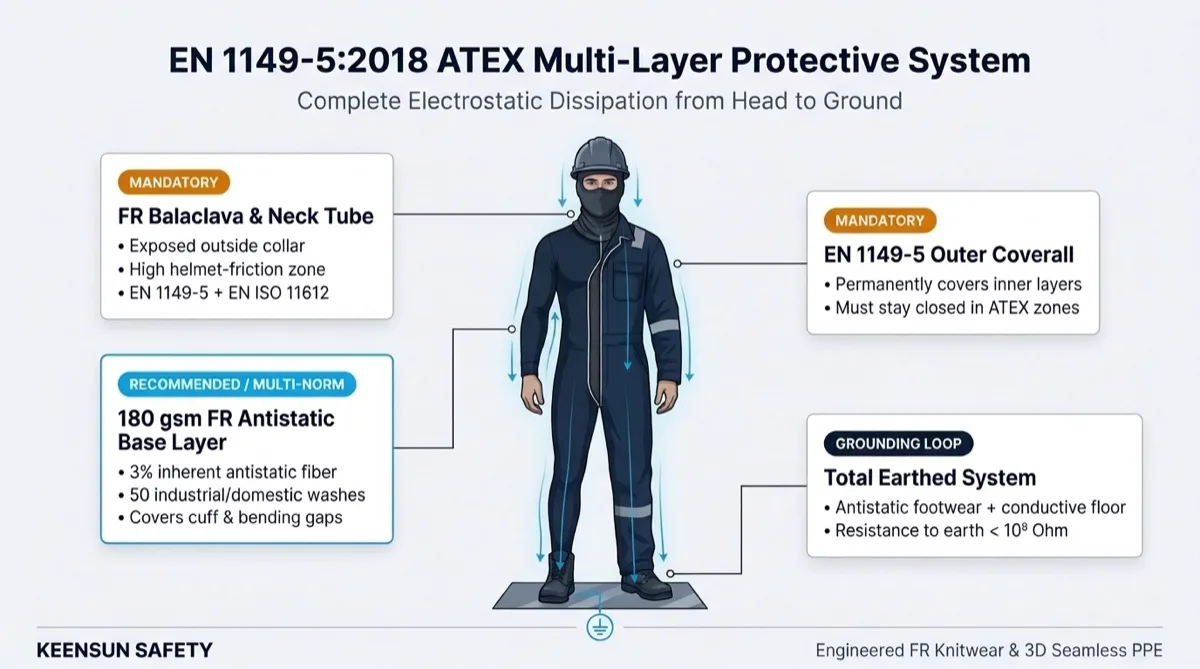
Quick Verdict: Base Layers vs. Balaclavas Under EN 1149-5
| Garment Type | Strictly Required by EN 1149-5:2018? | Real-World Industry Requirement | Key Compliance Driver |
|---|---|---|---|
| FR Balaclavas & Neck Tubes | Yes (when worn in ATEX zones) | Mandatory | Exposed outside the outer collar; sits directly against hair and safety helmet (high friction zone). |
| FR Base Layer Tops & Bottoms | Only if exposed during wear | Strongly Recommended / Often Mandated | Prevents hidden static buildup, covers bending/collar gaps, and enables safe single-layer wear in warm zones. |
| FR Outer Coveralls / Jackets | Yes | Mandatory | Must permanently cover all non-dissipative inner layers during normal movement. |
New to the standard? Read our foundational breakdown first: EN 1149-5 Standard Explained: Why Antistatic Protection Matters in Hazardous Work Environments.
Why FR Balaclavas and Neck Tubes Must Comply with EN 1149-5
Under EN 1149-5:2018, the golden rule of electrostatic dissipative clothing is permanent coverage: any non-dissipative material must be completely covered by EN 1149-5 compliant fabric at all times during normal movement—including bending, reaching, and kneeling.
FR balaclavas, hoods, and neck tubes cannot rely on outer-layer coverage because they sit on the outside.
- Direct Exposure in Explosive Atmospheres: Unlike thermal leggings hidden beneath FR trousers, a balaclava or neck gaiter protrudes above the jacket collar and frames the face. Standard FR knitwear without conductive fibers creates an unshielded surface capable of accumulating and discharging static right in the worker's breathing and working zone.
- High Triboelectric Friction Around the Head: Hair, sweat evaporation, and constant contact with polycarbonate safety helmets or arc-flash face shields generate surprisingly high electrostatic charges. Without conductive dissipation built into the knit, a non-antistatic hood can store charge directly beneath the helmet liner.
- Explicit Coverage in the Standard: EN 1149-5 specifically accounts for protective hoods and caps. To maintain system integrity, an antistatic balaclava or neck tube must overlap cleanly with the outer garment collar so no non-compliant inner layers are exposed when the worker turns or tilts their head.
For PPE brands sourcing headwear, combining EN ISO 11612, IEC 61482-2, and EN 1149-5 into a single 3D seamless knitted FR balaclava eliminates compliance blind spots while giving end-users a comfortable, pressure-free multi-norm accessory.
Do FR Base Layers and Underwear Need EN 1149-5?
Strictly by the text of EN 1149-5:2018, if an outer EN 1149-5 coverall completely and permanently covers the wearer's base layers during all tasks, the undergarments are not legally required to carry standalone EN 1149-5 certification.
In practice, however, major European refineries, offshore platforms, and chemical operators increasingly mandate EN 1149-5 certified FR base layers across their entire uniform program. Four real-world factors drive this requirement:
- Eliminating Exposure Gaps During Movement: Reaching overhead, climbing ladders, or crouching causes cuffs to ride up and collars to gap. If the underlying FR base layer is not EN 1149-5 compliant, even a brief exposed sleeve cuff technically breaks compliance.
- Enabling Safe Single-Layer Wear in Warm Climates & Transition Zones: During summer turnarounds or inside warm indoor plant zones, workers often wear lightweight long-sleeve FR base layers as their primary garment. Certifying the base layer to EN 1149-5 removes ambiguity for EHS supervisors.
- Preventing Hidden Triboelectric Charge Between Layers: Everyday synthetic thermal underwear (such as standard polyester or nylon) builds heavy static charge through friction against outer linings—and carries a severe melt-and-drip risk in flash fires. Embedding permanent conductive fibers into the next-to-skin layer helps equalize charge close to the body rather than trapping it beneath the outer shell.
- Winning Multi-Norm European Tenders: Offering a complete, audit-ready multi-norm layering kit—where base layers, balaclavas, and outer coveralls share aligned EN ISO 11612 + IEC 61482-2 + EN 1149-5 protection—gives workwear brands and distributors a decisive edge in industrial tenders.
Engineering EN 1149-5 into Knitted Base Layers: Inside a 180 GSM Multi-Norm Construction
Adding antistatic performance to heavy woven coveralls is straightforward—mills simply weave a visible carbon grid into the twill. Engineering EN 1149-5 into soft, stretchy, body-mapped FR knitwear that survives industrial laundering is a much steeper textile engineering challenge.
Here is how our 180 gsm Engineered FR Layering Platform—developed specifically for European private-label PPE programs—solves the core challenges of next-to-skin antistatic protection:
1. Five-Fiber Synergy with 3% Inherent Antistatic Loading
Many commercial FR knits rely on a bare-minimum 1%–2% conductive fiber ratio, leaving little safety margin after aggressive laundering or high-stretch wear. Our 180 gsm engineered construction balances five complementary fibers:
- 70% FR Viscose: Delivers a soft, breathable, cotton-like next-to-skin hand-feel with high moisture absorption for 12-hour shift comfort.
- 19% Aramid: Forms the inherent thermal skeleton—delivering high char strength, break-open resistance, and mechanical durability under industrial wear.
- 6% Polypropylene: Accelerates hydrophobic moisture transport away from skin so workers stay dry beneath heavy outer shells.
- 2% Elastane: Provides controlled ergonomic stretch and shape recovery across active joints without sacrificing FR compliance.
- 3% Antistatic Fiber: A generous, permanently integrated conductive fiber loading engineered to keep electrostatic dissipation stable across body-mapped mesh, rib, and high-stretch zones.
Evaluating fiber systems across climates? Compare options in our guide: Modacrylic vs. Merino Wool: Choosing the Right FR Base Layer.
2. Proven Durability Through 50 Industrial or Domestic Washes
EN 1149-5 requires materials to pass testing after a minimum of 5 wash cycles—a baseline that temporary chemical antistatic finishes can sometimes pass on paper before washing out in real service. For European workwear rental programs and industrial laundries, 5 washes is nowhere near sufficient.
Because our 3% antistatic fibers are inherently knitted into the yarn structure, this 180 gsm platform is engineered to maintain protective and electrostatic performance through 50 industrial or domestic wash cycles—lowering total cost of ownership for corporate PPE fleets.
3. EN 1149-3 (Charge Decay) vs. EN 1149-1 (Surface Resistivity)
EN 1149-5 qualifies fabrics through either of two test methods:
- EN 1149-1 (Surface Resistivity): ≤ 2.5 × 10⁹ Ω on at least one surface.
- EN 1149-3 (Charge Decay, Method 2 – Induction Charging): Half-decay time t₅₀ < 4 seconds or shielding factor S > 0.2.
In soft, next-to-skin FR knits where conductive filaments are cushioned inside FR viscose and aramid yarns for skin comfort, surface resistivity (EN 1149-1) can produce misleading failures even while the fabric comfortably passes EN 1149-3 charge decay. Specifying EN 1149-3 up front in your tech pack and lab booking (SGS, Intertek, BTTG, or Aitex) prevents costly re-testing delays. See our full Standards & Testing Matrix for lab coordination details.
4. Body-Mapped 3D Seamless Zones & Tagless Design Compliance
Fabric certification alone does not guarantee garment-level EN 1149-5 compliance—seams, trims, and labels all affect certification.
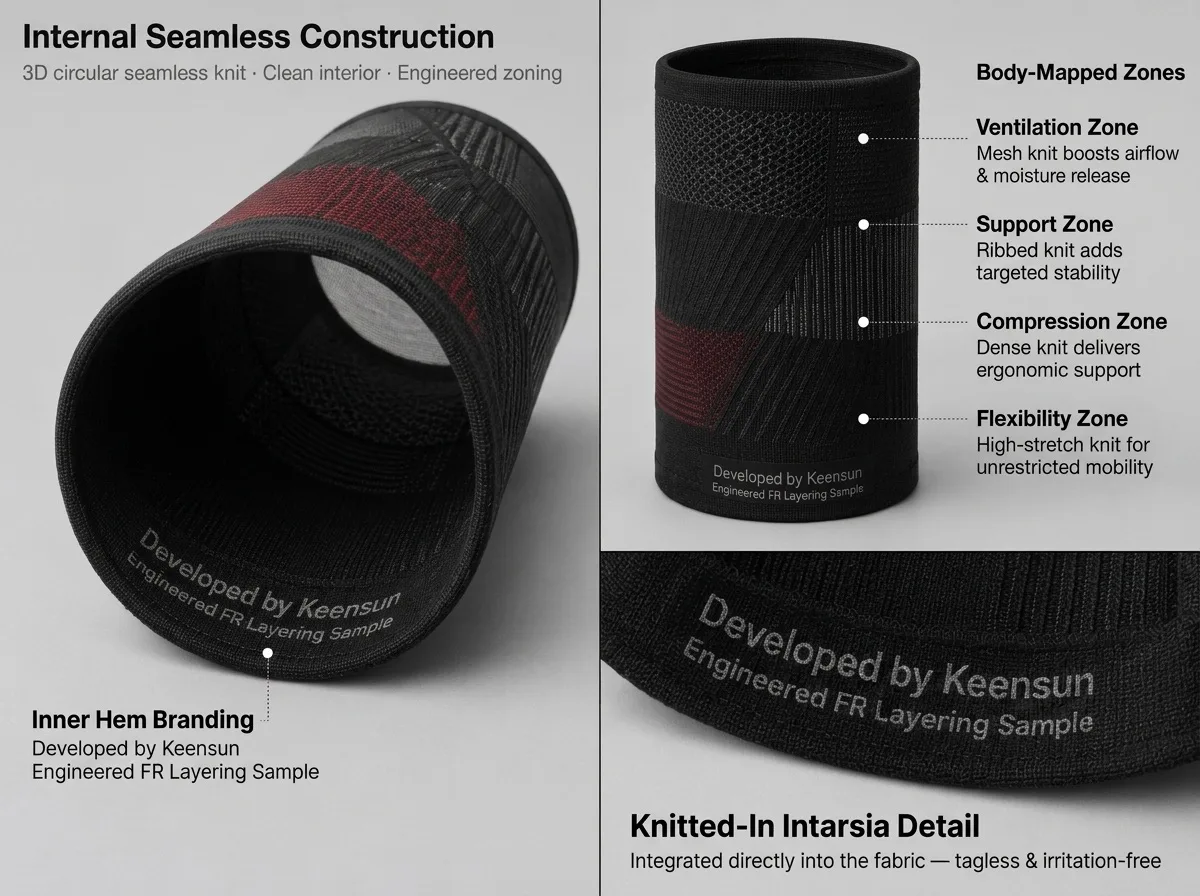
- Body-Mapped Seamless Zoning: Using circular 3D seamless knitting, we integrate four functional zones—Ventilation (mesh), Support (ribbed), Compression (dense knit), and Flexibility (high-stretch)—eliminating bulky cut-and-sew seams under harnesses or hard hats while preserving conductive continuity (spacing ≤ 10 mm) across the knit.
- Knitted-In (Intarsia) Branding Instead of Non-Conductive Labels: Under EN 1149-5, large non-dissipative heat-transfer badges, plastic labels, and exposed metallic trims are tightly restricted. Knitting branding directly into the inner hem via intarsia construction eliminates skin irritation and avoids unnecessary non-conductive surface attachments.
- Hardware Shielding: On half-zip base layers, any metallic zipper or puller must be fully covered so no isolated conductive hardware remains exposed.
Critical Safety Reminders for End-Users
Even the highest-performing EN 1149-5 base layer or balaclava operates within strict operational limits that PPE brands must state clearly in user instructions:
- EN 1149-5 is not flame resistance on its own: Always pair it with thermal standards such as EN ISO 11612 (heat and flame) and IEC 61482-2 (arc flash).
- Clothing alone cannot ground a worker: EN 1149-5 garments only function as part of a total earthed system—wearers must maintain resistance to earth < 10⁸ Ω through certified antistatic footwear and dissipative flooring.
- Never unzip or remove layers inside an ATEX zone: Opening or doffing garments in a hazardous atmosphere can trigger an incendiary discharge.
- Oxygen-enriched atmospheres: EN 1149-5 protective clothing must not be used in oxygen-enriched environments without prior approval from a qualified safety engineer.
Frequently Asked Questions (FAQ)
Develop Your EN 1149-5 FR Base Layer & Seamless Balaclava Line
Evaluate our 180 gsm platform (70% FR Viscose / 19% Aramid / 6% PP / 2% Elastane / 3% Antistatic — built for 50 industrial or domestic washes) with custom body-mapped zoning, knitted-in private-label branding, and SGS / Intertek / BTTG / Aitex lab coordination.